





Editor: Ananth Suresh
Introduction
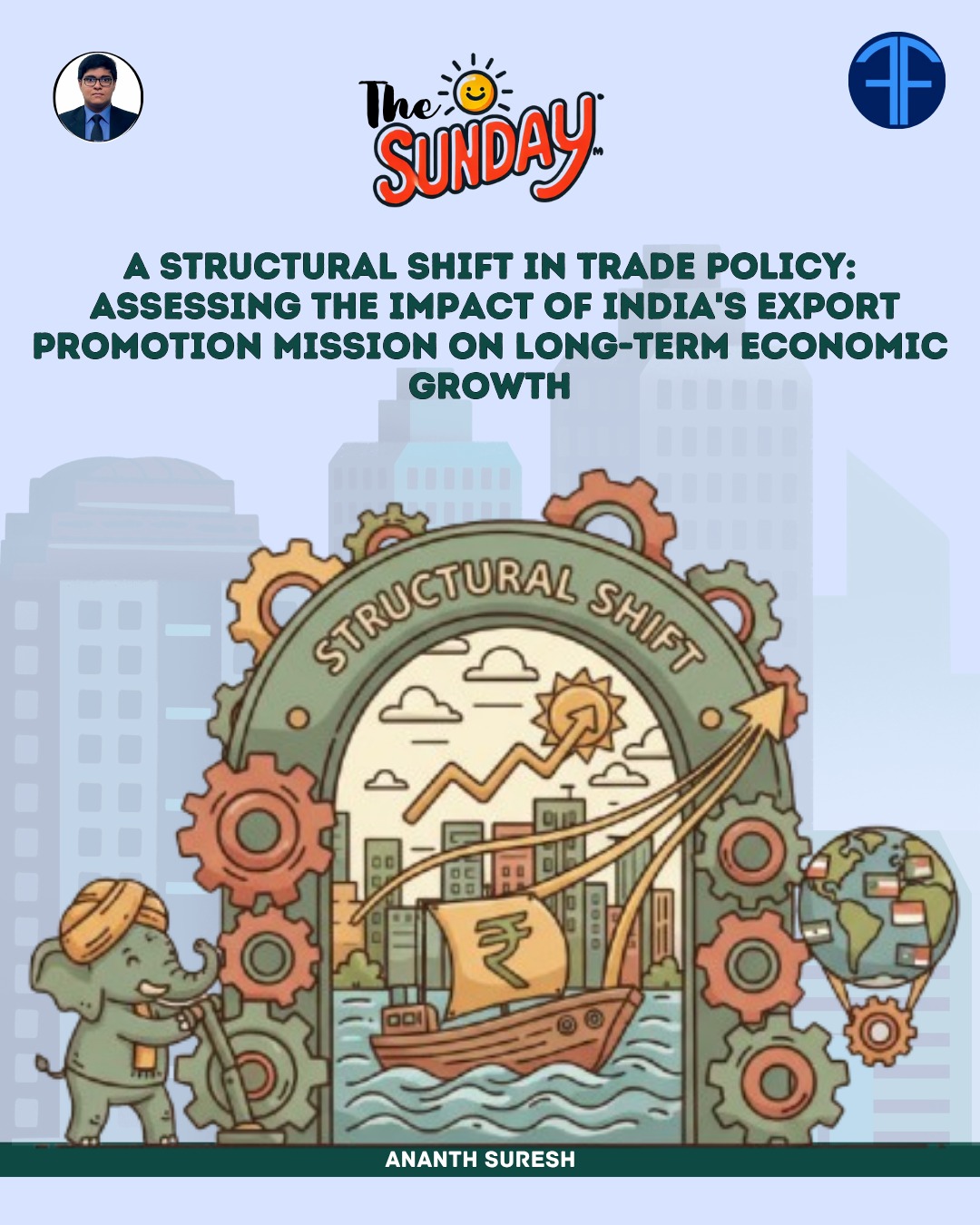
Exports play a major role in India’s economy and made up about 21 percent of GDP in 2024. For many years, support for exporters came through separate schemes that solved only small parts of the problem. Firms still faced slow credit, weak market access, and high logistics costs. Recent shocks made these gaps harder to ignore. Tariff increases, supply chain delays, and unstable demand showed that India needed a steady and long-term export plan. The Export Promotion Mission, approved in 2025 with an outlay of 25,060 crore rupees, aims to provide that plan by putting finance, branding, logistics, and market access into one system.
A Mission Built for Scale
The mission has two main parts. Niryat Protsahan focuses on finance, and it provides credit guarantees, export insurance, interest support, and simpler access to working capital. Niryat Disha covers non-financial needs such as branding, global standards, and logistics. These efforts target sectors that employ large numbers of workers. Engineering goods alone brought in about 116 billion dollars in 2024 to 2025, and this sector accounts for more than a quarter of India’s merchandise exports. Other labour-heavy sectors such as textiles, leather, marine products, gems, and jewellery also stand to benefit.
Why the Timing Matters
The United States, Europe, and other regions have raised tariffs on several Indian products, and this has made India’s exporters to be facing a very difficult global market now. Many firms still deal with port delays, changing freight rates, and weaker demand from major buyers. At the same time, new opportunities are opening in markets that India has not focused on before. India has expanded export outreach to around fifty new countries to reduce dependence on a few large markets. The mission comes at a time when firms need predictable rules and faster access to finance. Cheaper and quicker credit helps them manage cash flow when demand is uncertain.
Long-Term Growth Effects
A strong export base can support long-term growth by raising the trade to GDP ratio and spreading demand across more sectors. The mission aims to help firms shift from low-value goods to higher-value products. India has more than 6.8 crore MSMEs that employ about 30 crore people and even a small rise in the number of exporting MSMEs can create significant local jobs. Inland states also gain when export clusters expand beyond coastal cities. Better standards, improved branding, and smoother logistics help Indian firms build a stronger presence in global value chains.
Strengthening Supply Chains and Infrastructure
The cost of logistics in India is very high and costed around 7.97% of India’s GDP in 2023-24.The export promotion mission works with the National Logistics Policy and the PM Gati Shakti plan to improve roads, ports, and rail networks and this can reduce delays through faster customs clearance and better digital paperwork. Digital tracking can help exporters follow shipments from factory to port. These improvements make goods more reliable and help India compete with countries that move goods faster and cheaper.
Empowering MSMEs and First-Time Exporters
Most exports come from firms that already have global experience. Many capable firms still do not export because they struggle with standards, paperwork, and compliance. The mission tries to fix this by creating training programs, simpler documentation, and better links to export clusters. Empowering MSMEs can lead to job creation in both urban and rural areas.
Building Predictable Policy
Exporters need clear rules to plan production and pricing. Sudden changes increase uncertainty which can be tackled by the mission by aiming to provide steady policy and fixed timelines for decisions. Predictable rules help exporters commit to long-term contracts and build trust with foreign buyers.
Reducing Hidden Costs
Many exporters lose time and money to delays, uneven paperwork, and local compliance rules. These costs do not appear in any data, but they hurt competitiveness. The mission reduces these hidden costs by pushing digital systems and common documentation standards thereby helping smaller firms that cannot afford large compliance teams.
Aligning With Global Standards
Foreign markets expect consistent quality, and this has been considered by the mission which states about expanding testing labs, certification centres, and quality audits. Better quality systems reduce the risk of rejected shipments. They also help exporters enter strict markets such as Europe and Japan and ensuring stronger standards will make Indian goods more trusted worldwide.
Risks and Execution Challenges
The mission will work only if execution is strong. Expanding credit increases risk if loans are not monitored, a global slowdown could reduce demand and slow progress, delays in infrastructure projects may limit the mission’s impact. Coordination between central ministries, state governments, and exporter groups will determine how well the mission performs.
Conclusion
The Export Promotion Mission marks a clear change in India’s trade strategy and aims for steady, long-term support rather than short-term incentives and brings finance, standards, logistics, and market access together in one plan. If implementation stays on track, the mission can help India move higher in global value chains and support long-term growth across regions. Thus it positions exports as a core part of India’s future economic strategy.










Leave a comment